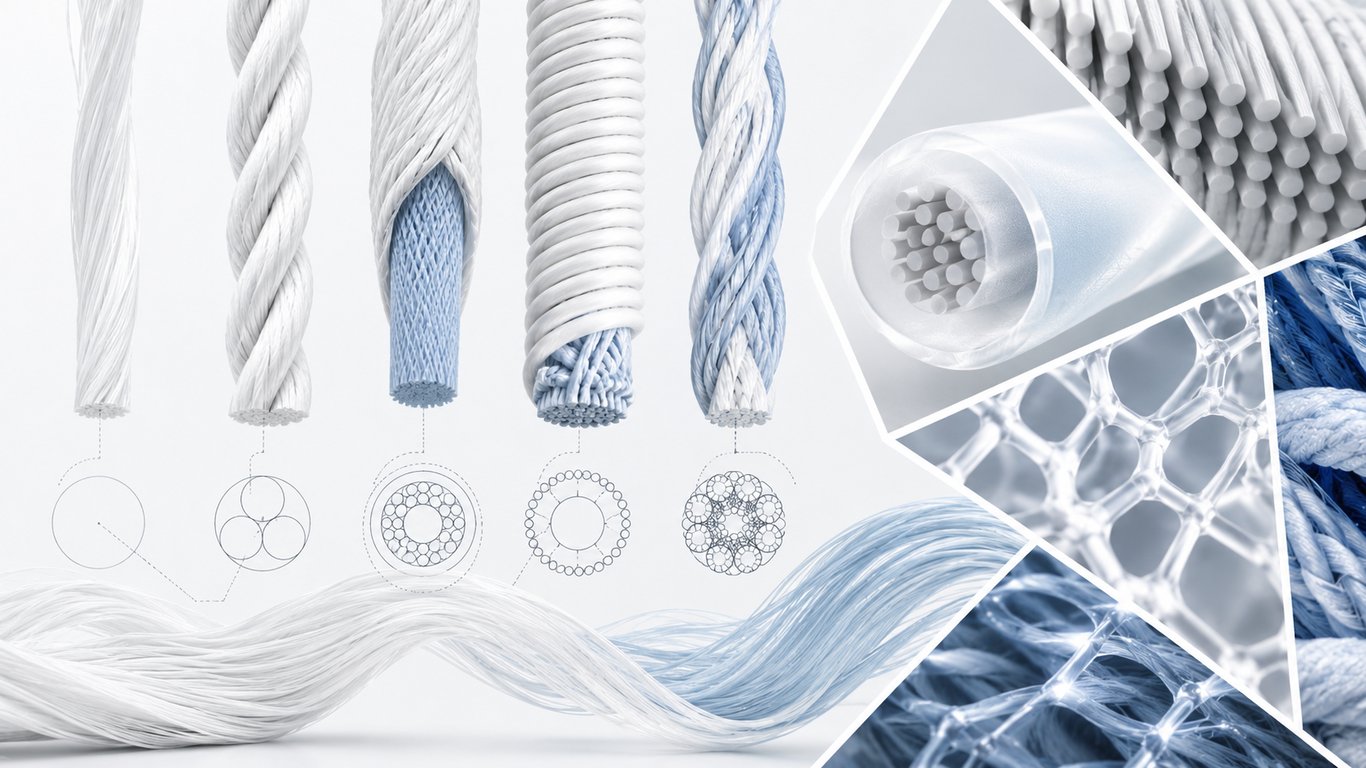
Yarn processing is the transformation of loose fiber materials into continuous yarn systems.
At the beginning of this process, fibers usually exist as a disordered assembly. They may be compressed, tangled, mixed with impurities, uneven in length, bent, hooked, curled, or poorly aligned. At the end of the process, those fibers are expected to form a continuous strand with enough strength, uniformity, appearance, and handling stability for downstream use.
This transformation is not a single action. It is a sequence of mechanical, physical, and sometimes chemical operations that gradually change the state of fibers.
In simple terms, yarn processing does two things:
It loosens the old disordered fiber assembly.
It builds a new ordered fiber assembly.
This is why yarn processing is not just a manufacturing workflow. It is a structural transformation system. It changes how fibers are opened, cleaned, mixed, aligned, drafted, twisted, combined, and finally stabilized into usable yarn.
1. What Yarn Processing Means
Yarn processing refers to the group of operations used to convert fibers into yarn.
The processing route may vary depending on fiber type, yarn type, required quality, and end application. Cotton, wool, flax, hemp, silk waste, regenerated fibers, polyester staple, nylon staple, aramid staple, and blended fibers do not always follow the same route. Their fiber length, fineness, stiffness, crimp, surface friction, moisture behavior, and impurity level are different, so their processing systems must also differ.
However, the basic purpose remains consistent:
Prepare fibers for controlled arrangement
Remove unsuitable impurities or short fibers when necessary
Improve fiber mixing and uniformity
Align fibers in a more longitudinal direction
Draft fiber assemblies to the required fineness
Add twist or other binding mechanisms to create yarn strength
Wind yarn into a package suitable for storage, transport, or further processing
A yarn is not created only by twisting fibers together. Twist is important, but it is only one part of the whole system. Before twisting can create a stable yarn, fibers must first be opened, cleaned, arranged, and drafted into a suitable fiber strand.
This is why yarn processing should be understood as a sequence of preparation, organization, consolidation, and packaging.
2. The Core Logic of Spinning: Loosening and Assembly
The core logic of spinning can be described through two opposite but connected actions:
Loosening → AssemblyFibers in raw or semi-prepared form often have many uncontrolled lateral connections. They may be packed into bales, tangled into clumps, stuck together by natural impurities, held by fiber hooks, or compressed by previous handling. Before a stable yarn can be formed, these uncontrolled connections must be reduced.
This is the loosening side of yarn processing.
After loosening, fibers cannot remain completely separate and disordered. They must be gathered again into a new structure. This new structure should have more longitudinal order, better uniformity, and enough fiber-to-fiber interaction to support yarn formation.
This is the assembly side of yarn processing.
The important point is that yarn processing does not simply destroy fiber connections. It replaces one kind of connection with another.
Raw fiber assemblies usually contain irregular, local, and uncontrolled connections. Yarn processing breaks these down and builds a more useful connection system: fibers are gradually aligned, drafted, combined, and fixed into a continuous yarn.
This is the real engineering logic behind spinning.
3. The Main Yarn Formation Path
Although different spinning systems may use different machines and routes, the fundamental yarn formation path can be understood through four main processing actions:
Opening → Carding → Drafting → TwistingThese four actions are central because they determine whether fibers can become yarn at all. Other processes may improve quality, cleanliness, evenness, or processing efficiency, but these four define the basic transformation from fiber assembly to yarn structure.
3.1 Opening
Opening is the first step in breaking down large fiber masses.
Fibers often arrive in compressed bales, clumps, bundles, or entangled masses. Opening reduces these large fiber assemblies into smaller tufts or bundles so that later processes can work more effectively.
Opening helps to:
Reduce fiber mass size
Loosen compressed fibers
Prepare fibers for cleaning
Improve mixing between fiber lots
Reduce large-scale unevenness
Prepare fiber bundles for carding
Opening must be controlled carefully. If opening is too weak, fiber clumps remain and later processes become unstable. If opening is too aggressive, fibers may be damaged, shortened, or over-stressed.
Good opening is not about tearing fibers apart as strongly as possible. It is about reducing fiber assemblies while preserving fiber quality.
3.2 Carding
Carding is the main process for further loosening fiber bundles and arranging fibers into a more usable form.
During carding, fibers are acted upon by surfaces covered with fine teeth, needles, or wire clothing. These surfaces separate fiber bundles, remove some impurities and neps, mix fibers further, and begin to form a more continuous fiber web or sliver.
Carding helps to:
Separate fiber bundles into smaller units or individual fibers
Remove some impurities, short fibers, and defects
Improve fiber mixing
Begin fiber alignment
Form a web or sliver
Prepare material for drafting
Carding is often the first major step where a disordered fiber mass starts to become a more organized textile material. However, carded fibers are not yet fully straight or parallel. Many fibers still contain hooks, bends, or irregular orientation.
This is why carding is important but not sufficient by itself.
After carding, the fiber assembly usually becomes a sliver. A sliver is not yarn. It has almost no twist and limited strength. But it is a more controlled fiber assembly that can be drafted, doubled, combed, or further processed.
Carding is where fiber disorder begins to become textile order.
3.3 Drafting
Drafting draws a fiber assembly into a finer and longer form.
After carding, the fiber assembly is usually still too thick and not sufficiently aligned. Drafting reduces the linear density of the sliver or roving by pulling fibers apart along the length direction. During this process, fibers become more straightened and more parallel.
Drafting helps to:
Reduce thickness
Improve fiber orientation
Increase fiber straightness
Remove some hooks and bends
Control yarn count or linear density
Prepare the fiber strand for twisting
Drafting is one of the most delicate processes in yarn formation because fibers do not all move at the same time. Some fibers are controlled by one roller pair, while others are transitioning between roller speeds. This creates a drafting zone where fiber control, friction, length distribution, and roller settings all matter.
Poor drafting may lead to:
Uneven yarn
Thick and thin places
Fiber slippage
Drafting waves
Weak spots
Higher end breakage
Poor yarn appearance
Drafting is not only a size-reduction process. It is also a fiber control process.
In yarn engineering, drafting connects fiber length, fiber friction, fiber straightness, and yarn evenness.
3.4 Twisting
Twisting fixes the drafted fiber strand into a yarn.
Before twisting, the fiber strand has been opened, carded, and drafted, but the fibers still need a stable binding mechanism. Twisting rotates the fiber strand around its own axis, causing fibers to hold together through helical arrangement, friction, pressure, and fiber-to-fiber contact.
Twisting helps to:
Give yarn strength
Stabilize the fiber strand
Improve abrasion resistance
Control yarn compactness
Influence stiffness and flexibility
Affect yarn appearance and handle
Influence downstream processing behavior
Twist is one of the most important structural variables in yarn design.
Too little twist may produce weak, loose, unstable yarn. Too much twist may make yarn hard, less flexible, and sometimes lower in strength after the optimum twist point. The correct twist level depends on fiber length, fiber fineness, fiber surface, yarn count, intended use, and downstream processing.
Twist direction also matters. S twist and Z twist influence yarn behavior in plying, sewing, knitting, weaving, and other downstream operations.
Twisting is not only a final step. It is the moment when a drafted fiber strand becomes a coherent yarn structure.
3.5 Spinning Technologies: Twist Formation Methods
In Section 3.4, twisting was described as a general principle: rotating a fiber strand to bind fibers together through helical arrangement, friction, and pressure. But how twist is created — the machine mechanism, the fiber path, and whether twist acts on a continuous fiber strand or a broken-and-reassembled open end — fundamentally determines yarn structure, yarn properties, production speed, and application suitability.
Following the classification framework established in Spinning Science (郁崇文, 3rd Edition, 2019), spinning technologies are organized into two major groups based on their relationship to conventional ring spinning:
- Ring spinning innovations (环锭纺改革技术): Technologies built on the ring spinning platform that share the same fundamental twist mechanism — a continuous fiber strand twisted by spindle-ring-traveler rotation — but modify the drafting zone, fiber feed, or consolidation method to improve specific yarn properties.
- New spinning technologies (新型纺纱): Technologies that create twist through a completely different physical mechanism from ring spinning. These are further divided into open-end spinning (自由端纺纱), where the fiber stream is broken into individual fibers and re-condensed at a free open end before twist insertion, and non-open-end spinning (非自由端纺纱), where fibers remain in a continuous strand and twist is created by air jets, mechanical oscillation, or wrapping mechanisms.
Classification of Spinning Technologies
Spinning Technologies (纺纱技术)
│
├── Ring Spinning Innovations (环锭纺改革技术)
│   │  Same twist mechanism as ring spinning;
│   │  modifications to drafting zone, feed, or consolidation
│   │
│   ├── Conventional Ring Spinning (传统环锭纺) ← the reference standard
│   ├── Compact Spinning (集聚纺/紧密纺) → adds pneumatic fiber condensation
│   ├── Siro Spinning (赛络纺) → dual roving parallel feed
│   ├── Sirofil Spinning (赛络菲尔纺) → one roving + one filament
│   └── Solospun / Cable-type Spinning (缆型纺) → split-roller fiber grouping
│
└── New Spinning Technologies (新型纺纱)
    │  Twist mechanism fundamentally different from ring spinning
    │
    ├── Open-End Spinning (自由端纺纱)
    │   │  Fiber stream broken → individual fibers
    │   │  → re-condensed at free open end → twist inserted
    │   │
    │   ├── Rotor Spinning (转杯纺) ← most mature, dominant OE technology
    │   ├── Friction Spinning (摩擦纺 / DREF)
    │   ├── Vortex Spinning (涡流纺) ← open-end variant, limited commercial use
    │   └── Electrostatic Spinning (静电纺) ← experimental/niche
    │
    └── Non-Open-End Spinning (非自由端纺纱)
        │  Fiber strand remains continuous;
        │  twist/wrapping created externally
        │
        ├── Air-Jet Spinning (喷气纺 / MJS) ← Murata Jet Spinner
        ├── Air-Jet Vortex Spinning (喷气涡流纺 / MVS) ← Murata Vortex Spinner
        ├── Self-Twist Spinning (自捻纺 / REPCO)
        └── Wrap Spinning (包缠纺)
This classification reflects a fundamental engineering distinction: whether the fiber strand remains continuous from supply to yarn (ring-based and non-open-end types), or is broken and reassembled at a free end (open-end types). This distinction directly shapes yarn structure, fiber arrangement, and final properties.
3.5.1 Conventional Ring Spinning (传统环锭纺)
Ring spinning is the reference standard. All other spinning technologies are compared against it. It was commercialized in the early 19th century and remains the most versatile spinning method, capable of producing yarns across the widest count range from virtually any staple fiber.
Principle
A roving is drafted to the target fineness by a roller drafting system (typically 3-roller with double aprons). The drafted fiber strand passes through a yarn guide, threads through a small C-shaped traveler riding on a ring encircling the spindle, and is wound onto a rotating bobbin. The spindle rotates at 15,000–25,000 rpm. The traveler, dragged around the ring by the yarn tension, runs at a slightly lower speed due to friction. Each traveler revolution relative to the yarn strand inserts one turn of true twist. Because twist insertion and winding occur simultaneously, ring spinning is an integrated twist-and-wind process.
Key Machine Components
- Drafting system: 3-roller or 4-roller drafting unit with top and bottom aprons for fiber control in the main drafting zone; total draft ratio typically 20–50
- Spindle: High-speed rotating shaft carrying the bobbin; modern spindles use bearing-absorber-damper systems for high-speed stability
- Ring: Hardened steel ring (typically 36–54 mm diameter) with a precision-ground flange on which the traveler rides
- Traveler: Small C-shaped element (steel or nylon) that guides yarn onto the bobbin; its weight and profile control spinning tension
- Balloon control ring: Limits yarn balloon diameter to reduce tension variation and yarn breakage
- Ring frame manufacturers: Rieter (G-series), Toyota (RX-series), LMW (LR-series), Marzoli, Zinser (Saurer group)
Yarn Structure
Ring-spun yarn has a true helical twist structure. Fibers migrate between the yarn core and surface in a semi-random pattern driven by the tension variations in the spinning triangle — the triangular zone between the front roller nip and the twist convergence point. This migration creates strong fiber-to-fiber interlocking. The surface carries naturally protruding fiber ends, giving ring-spun yarn its characteristic soft hand feel but also creating hairiness.
Advantages
- Broadest count range: Ne 2 to Ne 120+, covering coarse industrial yarns to ultra-fine shirting yarns
- Applicable to virtually all staple fibers and blends: cotton, wool, linen, synthetics, aramid, and other high-performance fibers
- Highest yarn strength among commercial technologies (best fiber utilization efficiency through true twist and fiber migration)
- Soft, natural hand feel — the benchmark for textile comfort
- Z-twist or S-twist by simple spindle rotation direction change
- Universal downstream compatibility: knitting, weaving, sewing thread, technical textiles
Limitations
- Lowest production speed: delivery 15–30 m/min — the fundamental physics constraint of ring-traveler friction and heat generation
- Requires roving as input (adds one processing step vs. rotor/vortex spinning)
- High hairiness increases fiber fly, sizing consumption, and downstream processing issues
- Higher labor and energy cost per kg of yarn
- Traveler speed limited to approximately 40 m/s surface speed; beyond this, friction heat destroys the traveler
- Large floor space per unit output
Typical Applications
- High-quality apparel fabrics (shirting, suiting, dresses)
- Sewing thread
- Fine-gauge knitwear
- Technical yarns requiring fiber versatility and maximum strength
- Any application where yarn quality is the highest priority
3.5.2 Compact Spinning (集聚纺 / 紧密纺)
Compact spinning is a ring spinning innovation. It does not change the twist mechanism — twist is still inserted by ring and traveler. It modifies the drafting zone exit by adding a pneumatic or mechanical fiber condensation (compacting) zone that laterally compresses the fiber strand before twist insertion.
Principle
After the front drafting roller, fibers pass over a perforated suction drum or a perforated lattice apron under negative pressure. Airflow pulls the loose fiber edges inward, condensing the fiber strand from a flat ribbon into a narrow, nearly circular bundle. Twist is then inserted into this already-compact fiber assembly. The spinning triangle — the free-floating zone where fibers spread laterally before being twisted — is nearly eliminated. Because fibers enter the twisting zone already gathered, fewer fiber ends protrude from the yarn surface.
Key Machine Components (in addition to standard ring frame)
- Condensation zone: Perforated suction drum (Rieter Com4® system), lattice apron (Süssen EliTe® system), or suction slot (Toyota/Truetzschler systems)
- Negative pressure system: Central vacuum unit or individual spindle suction; typical vacuum level: 1.5–3.0 kPa
- Air-guide element: Directs airflow to achieve lateral fiber condensation
Yarn Structure
Compact yarn retains the helical true-twist structure of ring-spun yarn, but with dramatically fewer surface fiber ends. Fiber ends are largely integrated into the yarn body. Fiber packing density is higher and more uniform. The yarn cross-section is more circular. The fundamental difference from conventional ring-spun yarn is not the twist structure, but the surface integrity — fewer loose fiber ends protrude from the yarn surface.
Advantages vs. Conventional Ring Spinning
- Hairiness reduced by 60–80%
- Strength increased by 10–15% at the same twist level
- Can achieve target strength with 5–10% lower twist (enabling softer hand feel at equivalent strength)
- Improved yarn evenness and fewer imperfections
- Reduced fiber fly in downstream processing (weaving, knitting)
- Improved abrasion resistance
- Warp sizing agent can be reduced by 30–50%
Limitations
- Machine cost 20–30% higher than conventional ring frame
- Energy consumption for vacuum/negative pressure system (additional 5–10% power)
- Requires cleaner operating environment (suction perforations can clog with fiber dust and wax)
- Yarn hand feel is slightly firmer than conventional ring-spun (less surface fiber softness)
- Higher maintenance requirement for suction and perforated components
Typical Applications
- High-end shirting and suiting
- Fine-gauge knitwear requiring smooth surface
- Sewing thread (reduced hairiness improves high-speed sewing performance)
- Fabrics requiring low pilling and clean surface finish
3.5.3 Siro Spinning (赛络纺)
Siro spinning is a ring-frame innovation originally developed by CSIRO (Australia) for wool spinning. It feeds two separate rovings in parallel at a controlled spacing into the same drafting system. The two strands are drafted separately and then twisted together at the convergence point, producing a two-strand pseudo-plied structure in a single spinning operation.
Principle
Two rovings enter the drafting zone side by side with a controlled separation gap (typically 6–12 mm). Each strand is drafted individually through the same roller drafting system. At the exit of the front roller, the two strands converge under twist and wrap around each other, forming an interlocked double-strand structure. Both strands receive twist in the same direction, so the result is not a true balanced ply yarn, but it mimics many ply-yarn properties. A break-out detection device is essential: if one strand breaks, the other must also be stopped to prevent single-strand defective yarn.
Key Modifications to Ring Frame
- Dual-roving guides with adjustable spacing control
- Double roving creel (creel capacity halved vs. conventional spinning)
- Break-out detection system at each spindle position
- Standard ring spinning frame otherwise unchanged
Yarn Structure
Siro-spun yarn has a visible two-strand twisted architecture. The surface is smoother than conventional ring yarn because fiber ends are partially trapped between the two sub-strands. The yarn has a subtle helical grooved surface. Fiber migration occurs both within each sub-strand and between the two strands, creating good structural integrity.
Advantages
- Hairiness reduced by 30–50% vs. conventional ring-spun (fiber ends trapped between sub-strands)
- Better abrasion resistance
- Improved anti-pilling performance
- Higher strength than conventional ring-spun at equivalent count
- Softer hand feel than compact yarn (less dense fiber packing)
- Eliminates separate plying step — two-ply-like yarn produced in one operation
- No vacuum/pneumatic system required (simpler than compact spinning)
- Two rovings can be different colors or materials for melange/ blended effects
Limitations
- Requires two rovings — creel capacity is halved, increasing roving change frequency
- Strand spacing must be precisely controlled; poor spacing leads to uneven yarn structure or single-strand sections
- Break-out detection system must be reliable; failure produces unusable single-strand yarn
- Not suitable for very fine counts where fiber count per sub-strand becomes too low (practical limit: Ne 80)
- Higher drafting forces due to dual-roving feed require "heavy pressing, large gauge, medium speed, medium nip" processing principle
Typical Applications
- Worsted and wool-blend fabrics (initially developed for this market)
- High-quality knitwear
- Shirting and lightweight suiting
- Applications requiring low-pilling and soft handle
3.5.4 Sirofil Spinning (赛络菲尔纺) and Solospun (缆型纺)
Two additional ring spinning variants deserve mention:
Sirofil Spinning (赛络菲尔纺): A variant of Siro spinning where one roving is replaced by a continuous filament (typically polyester or nylon). The filament is fed under controlled tension and converges with the staple fiber strand at the front roller exit. The filament wraps around the staple strand, binding surface fibers and dramatically reducing hairiness. The result is a composite yarn with a staple-fiber surface and a filament core component. Key applications include high-strength sewing thread and wrinkle-resistant suiting.
Solospun / Cable-Type Spinning (缆型纺): Developed primarily for wool, a small split-roller is installed in front of the front drafting roller to divide the drafted fiber strand into several sub-bundles. These sub-bundles twist individually and then converge, creating a cable-like multi-strand structure. The result is reduced hairiness and significantly improved abrasion resistance compared to conventional single yarn. It is used in worsted weaving where yarn must withstand high loom abrasion.
3.5.5 Rotor Spinning (转杯纺)
Rotor spinning is the dominant open-end spinning technology and the second most important spinning method globally after ring spinning. Commercialized in the 1960s (Czechoslovak BD 200, later Rieter, Schlafhorst), it represents a complete departure from ring spinning: the fiber supply is opened into individual fibers, and twist is inserted at the open end where these fibers re-condense.
Principle
A carded sliver (no roving required) is fed directly into the machine. A high-speed opening roller (combing roller, 6,000–10,000 rpm) covered with saw-tooth wire separates the sliver into individual fibers. These fibers are transported by an airstream through a transport channel into a rapidly rotating rotor (spinning cup). Inside the rotor, centrifugal force (up to 100,000 g) deposits fibers against the rotor wall in a collecting groove. Fibers accumulate in this groove as a fiber ring. A seed yarn introduced through the central exit tube contacts the fiber ring; the rotor's rotation twists the deposited fibers onto the yarn end, and the newly formed yarn is continuously withdrawn. Fiber collection in the groove and yarn withdrawal with twist insertion happen simultaneously but at different locations — this is the defining characteristic of open-end spinning.
Key Machine Components
- Feed system: Sliver feed roller and feed table with controlled feed rate
- Opening roller (分梳辊): Saw-tooth wire-covered roller, 6,000–10,000 rpm, separates sliver into individual fibers
- Transport channel: Air-conveyed fiber path; fiber orientation influenced by channel geometry
- Rotor (转杯): 28–66 mm diameter, 80,000–200,000 rpm; two types — self-venting (自排风式) and suction-type (抽气式); groove shape: V-groove (fine yarns) or U-groove (coarser yarns)
- Navel / Doffing tube (假捻盘/引纱管): Central exit tube; its surface generates false twist in the yarn formation zone
- Winding unit: Separate from twisting zone, enabling large package formation (3–5 kg)
- Key manufacturers: Rieter (R-series), Saurer Schlafhorst (Autocoro), Toyota, Jingwei (经纬)
Yarn Structure
Rotor-spun yarn has a characteristic three-zone layered structure fundamentally different from ring-spun yarn:
- Core zone: Relatively parallel, densely packed fibers forming the load-bearing center
- Sheath / Wrapping zone: Fibers wrapped around the core at varying angles, creating belt-like wrapping bands that provide structural cohesion
- Surface / Belt fibers: Irregularly wrapped surface fibers; some fiber ends are wrapped into the body, while others lie on the surface in a less organized arrangement
There is no consistent helical fiber migration from core to surface as in ring-spun yarn. The fiber arrangement is more random, with wrapping fibers providing the main binding mechanism rather than true twist. This structural difference explains most property differences between ring and rotor yarns.
Advantages
- Very high production speed: delivery 100–250 m/min (5–10× faster than ring spinning)
- Eliminates roving frame (sliver-to-yarn direct) — saves one complete processing step, floor space, energy, and labor
- Large package size (up to 4–5 kg cones), reducing creeling, knotting, and downtime in downstream processes
- Better yarn evenness and fewer imperfections (the fiber doubling effect in the rotor groove averages out short-term variations)
- Lower labor cost per kg of yarn produced
- Excellent automation potential — automatic doffing, piecing (robot splicer), rotor cleaning
- Less sensitive to short fiber content; can use lower-cost raw material
Limitations
- Yarn strength 15–25% lower than equivalent ring-spun yarn (less fiber parallelization, wrapper-fiber binding rather than true twist)
- Hand feel is harsher, stiffer, less soft (wrapping fiber structure limits fiber mobility)
- Practical count limit approximately Ne 40 (typically Ne 6–30 for economic production)
- Requires 10–20% more twist than ring-spun to achieve adequate strength (higher twist factor)
- Limited fiber length range: best with fibers ≤ 40 mm; longer fibers cause wrapping and spinning instability
- Hard waste generation higher
- Not suitable for all fiber types; works best with cotton, polyester, viscose, and their blends
Typical Applications
- Denim fabrics (largest rotor yarn market globally)
- Knitted casual wear (T-shirts, sweatshirts, fleece)
- Towels and terry fabrics
- Home textiles and upholstery
- Industrial wipes and cleaning textiles
- Economy and mid-range apparel where high productivity matters more than premium quality
3.5.6 Friction Spinning (摩擦纺 / DREF)
Friction spinning is an open-end technology that uses mechanical friction — rather than a rotor — to insert twist. It was developed by Dr. Ernst Fehrer (Austria) and commercialized as the DREF system.
Principle
Fibers are opened by a carding or opening roller and blown or fed into the nip between two perforated rotating friction drums (尘笼). The drums rotate in the same direction, and suction inside the drums holds the fibers. Fibers are condensed onto the yarn tail in the nip zone; the friction between the drum surfaces and the fiber assembly causes it to roll and twist. Because the twist insertion and winding functions are completely separate (unlike ring spinning), very high delivery speeds are possible.
Key Features
- Delivery speed: 100–300 m/min
- Can process very coarse fibers, short fibers, waste fibers, and recycled fibers that other systems cannot handle
- Produces very coarse yarns (Ne 0.5–12) suitable for industrial textiles
- Core-sheath structure: a filament or yarn core can be fed through the center while staple fibers form the sheath — widely used for technical yarns
- Friction ratio (尘笼表面速度/出纱速度) is the critical parameter controlling twist level and yarn quality
Limitations
- Very low yarn strength; fiber orientation is poor
- Limited to coarse counts
- High fiber damage (more severe than rotor spinning)
- Limited commercial application — primarily niche industrial products
3.5.7 Air-Jet Spinning (喷气纺 / MJS — Murata Jet Spinner)
Air-jet spinning is a non-open-end technology commercialized by Murata Machinery (Japan) in the 1980s. It was the first commercially successful spinning method to replace mechanical twisting with pneumatic twisting.
Principle
A drawn sliver is drafted by a high-draft system (typically 3-roller) directly to the final yarn count. The drafted fiber strand enters a two-nozzle air-jet system. The two nozzles inject compressed air in opposite tangential directions at high speed, creating oppositely rotating air vortices. The first nozzle (N1) creates a vortex that opens and separates the outer fibers from the core bundle. The second nozzle (N2) creates a counter-vortex that wraps these separated fibers around the parallel core as the yarn exits. The result is a wrapper-fiber yarn: parallel core fibers bound by helically wrapped surface fibers.
Key Machine Components
- High-draft 3-roller drafting system (from sliver to final count in one step)
- Dual air-jet nozzle assembly (N1 and N2) — the core patented Murata technology
- Compressed air system (typically 0.5–0.7 MPa)
- Winding unit for package formation
Yarn Structure
Air-jet yarn has a two-component wrapper-fiber structure: approximately 80–90% of fibers form a parallel, nearly twistless core; the remaining 10–20% are wrapped helically around the core. The yarn has a distinctive clean, smooth surface with very low hairiness. However, strength depends entirely on wrapper fiber binding, and the lack of true twist in the core limits strength and creates a stiffer hand feel.
Limitations
- Primarily limited to polyester and polyester/cotton blends; pure cotton spinning was limited in the original MJS (this constraint drove development of MVS)
- Yarn strength lower than ring-spun; not suitable for high-strength applications
- Stiffer hand feel — less suitable for soft-touch apparel
- Narrower count range than ring spinning
Note: The original MJS air-jet spinner has largely been superseded by the Murata Vortex Spinner (MVS), which solved the pure cotton spinning limitation through a fundamentally different nozzle design.
3.5.8 Air-Jet Vortex Spinning (喷气涡流纺 / MVS — Murata Vortex Spinner)
Vortex spinning is the most commercially successful modern spinning technology. Developed by Murata Machinery and commercialized as the Murata Vortex Spinner (MVS) in the late 1990s, it is an evolution of MJS air-jet technology but with a fundamentally different yarn formation mechanism — a single high-speed air vortex chamber rather than dual counter-rotating nozzles.
Principle
A drawn sliver is drafted by a 4-roller (or 4-line) drafting system. The drafted fiber strand enters a hollow spindle surrounded by an air vortex chamber. Compressed air is injected tangentially at high speed (0.5–0.65 MPa), creating a high-speed rotating air vortex around the hollow spindle tip. The vortex separates the trailing ends of fibers from the main fiber bundle entering the spindle. These separated trailing fiber ends are wrapped around the parallel core fibers as the yarn is drawn forward through the hollow spindle by the delivery rollers. The result is a yarn with a distinct core-sheath structure: a parallel fiber core carries tensile load, while wrapper fibers bind the structure together.
Key Machine Components (MVS System)
- 4-roller drafting system: Provides precise fiber control; high-speed front roller (up to 500 m/min)
- Hollow spindle (空心锭子): Central element through which yarn passes; its tip shape and surface affect fiber separation and wrapping
- Vortex chamber / Nozzle: Tangential compressed air injection creates the high-speed vortex; nozzle design is the core Murata patent
- Fiber guide member: Controls fiber feed orientation and angle into the vortex zone
- Winding unit: Separate from spinning zone; produces large cylindrical packages
- Manufacturer: Murata Machinery (exclusive); current models: MVS 870, MVS 8D
Yarn Structure
Vortex yarn has a distinctive core-sheath wrapper-fiber architecture:
- Core fibers (approximately 80–95%): Parallel, straight fibers forming the load-bearing center — essentially a drawn sliver core with minimal twist, carrying most tensile load
- Wrapper fibers (approximately 5–20%): Trailing fiber ends wrapped helically around the core at varying angles, creating the binding structure that holds the yarn together
This structure is unique among commercial spinning technologies. The parallel core gives vortex yarn its characteristic stiffness, low hairiness, and good water absorption (parallel fibers create capillary channels). The wrapper fibers provide cohesion without true twist. The absence of mechanical rotating elements at the twist insertion point enables exceptionally high speed.
Advantages
- Fastest commercial spinning technology: delivery speed up to 500 m/min
- Extremely low hairiness (lowest among all spinning technologies — even lower than compact yarn)
- Excellent anti-pilling performance (fiber ends securely trapped by wrapper fibers — resists migration to fabric surface)
- Good water absorption (parallel core fiber structure creates capillary wicking)
- High stiffness and shape retention — favorable for certain knit structures (polo collars, structured garments)
- Direct sliver-to-yarn — no roving needed
- Large package size; good automation and labor efficiency
- Spins 100% cotton successfully (unlike MJS) — a major commercial breakthrough
Limitations
- Yarn strength typically 10–20% lower than ring-spun (wrapper-fiber binding cannot match true-twist fiber utilization)
- Hand feel is firmer and stiffer — not ideal for soft-drape luxury apparel
- Fiber type range narrower than ring: primarily cotton, polyester, viscose, modal, and their blends; less suited to specialty or high-performance fibers
- Fiber length sweet spot: 28–38 mm; very short or very long fibers cause spinning instability or wrapping defects
- Count range narrower: typically Ne 20–60 (economic optimum Ne 30–40)
- Compressed air consumption adds energy cost (0.5–0.65 MPa continuous supply)
- Uneven wrapper fiber distribution can create localized weak spots
Typical Applications
- High-quality knitted products (polo shirts, sportswear, innerwear)
- Towels and bath linens (excellent water absorption + low lint generation)
- Socks and hosiery
- Bedding and home textiles
- Any product where low pilling and clean surface are critical requirements
3.5.9 Other New Spinning Technologies
Self-Twist Spinning (自捻纺 / REPCO): Developed by CSIRO (Australia), this non-open-end technology uses a pair of oscillating rollers to insert alternating S and Z twist into two parallel strands, which are then brought together. The strands untwist against each other, creating a self-locking plied structure. Limited to wool and long-staple fibers. Mostly supplanted by Siro spinning, which achieves similar benefits on conventional ring frames.
Wrap Spinning (包缠纺): A continuous filament is wrapped around a core of parallel staple fibers, binding them without twist. The staple core provides bulk and hand feel; the filament wrapping provides strength and cohesion. Used for specialty yarns where zero twist in the core is desired.
Electrostatic Spinning (静电纺): An open-end method where fibers are charged electrostatically and deposited on a rotating electrode, then twisted. Very limited commercial adoption due to low productivity and narrow fiber compatibility.
3.5.10 Comprehensive Comparison
Comparison of the five major commercially dominant technologies. Friction, electrostatic, air-jet (MJS), and self-twist spinning are excluded as they have either been superseded or occupy narrow niche markets.
Feature | Ring Spinning | Compact Spinning | Siro Spinning | Rotor Spinning | Vortex Spinning (MVS) |
|---|---|---|---|---|---|
Classification | Ring-based (reference) | Ring innovation | Ring innovation | New — Open-end | New — Non-open-end |
Twist mechanism | Ring + traveler (mechanical true twist) | Ring + traveler + pneumatic fiber condensation | Ring + traveler + dual strand convergence | High-speed rotor (centrifugal + mechanical twist) | High-speed air vortex (pneumatic wrapping) |
Fiber strand continuity | Continuous | Continuous | Continuous (2 strands) | Broken and reassembled (open end) | Continuous (wrapper fiber formation) |
Delivery speed | 15–30 m/min | 15–30 m/min | 15–30 m/min | 100–250 m/min | 350–500 m/min |
Input material | Roving | Roving | 2× Roving | Sliver (direct) | Sliver (direct) |
Count range (Ne) | 2–120+ | 20–120+ | 20–80 | 3–40 | 20–60 |
Relative strength | ★★★★★ (reference) | ★★★★★ (10–15% ↑) | ★★★★★ | ★★★★☆ (15–25% ↓) | ★★★★☆ (10–20% ↓) |
Hairiness | High (reference) | Very low (60–80% ↓) | Low (30–50% ↓) | Low–Moderate | Very low (lowest) |
Hand feel | Soft, natural | Slightly firmer | Soft, good bulk | Harsher, stiffer | Firm, structured |
Fiber versatility | All staple fibers | All staple fibers | Staple fibers; wool-developed | Cotton, synthetics, blends (≤ 40 mm) | Cotton, polyester, CVC, modal (28–38 mm) |
Anti-pilling | Moderate | Good | Good | Moderate | Excellent |
Processing steps skipped | None (full route) | None | Plying (single-step plied-like yarn) | Roving frame | Roving frame |
Machine cost (relative) | ★★☆☆☆ | ★★★★☆ | ★★★☆☆ | ★★★★☆ | ★★★★★ |
Energy (relative) | Medium | Medium–High (+vacuum) | Medium | Medium | Medium–High (+compressed air) |
Key manufacturers | Rieter, Toyota, LMW, Marzoli, Zinser (Saurer) | Rieter (Com4®), Süssen (EliTe®), Toyota, Truetzschler | Rieter, Zinser, Toyota (ring frame modification) | Rieter (R-series), Saurer Schlafhorst (Autocoro), Toyota, Jingwei | Murata (exclusive MVS; models 870, 8D) |
3.5.11 Structural Differences and Yarn Properties
The classification above is not academic taxonomy — it has direct engineering consequences for yarn structure and properties. The fundamental dividing lines are:
Continuous vs. Broken fiber strand (Ring-based and Non-open-end vs. Open-end): When the fiber strand remains continuous from drafting to twist insertion (ring, compact, siro, MVS), fibers can be more parallel and better aligned, resulting in better fiber length utilization and higher strength. When the fiber strand is broken and reassembled (rotor), fiber orientation is more random, and the yarn relies on wrapper fibers or belt fibers for cohesion rather than true twist — strength is lower, but evenness can be better due to the averaging effect in the reassembly process.
True twist vs. Wrapper fiber binding (Ring-based vs. MVS/Rotor): Ring-based technologies insert true twist — every fiber follows a helical path from yarn center to surface and back. This migration creates strong inter-fiber friction and efficient load transfer. MVS and rotor yarns rely on wrapper fibers (MVS) or belt/wrapping fibers (rotor) to bind a relatively parallel core. These wrapper fibers provide structural integrity but do not create the fiber-to-fiber load sharing of true twist structures. This is the fundamental reason why ring-spun yarns are stronger but hairier, while MVS yarns are weaker but nearly hairless.
Spinning triangle control (Conventional Ring vs. Compact/Siro): The spinning triangle is the weakest structural link in conventional ring spinning. Compact spinning nearly eliminates it through pneumatic fiber condensation, reducing hairiness and increasing strength. Siro spinning partially controls it through dual-strand convergence, trapping fiber ends between the two sub-strands. These are different solutions to the same problem, and their relative effectiveness explains the property differences among ring-spun variants.
The choice of spinning technology is a design decision. A yarn engineer selects the technology that produces the right combination of yarn structure, fiber utilization, production economics, and end-use performance — not the technology that is "best" in isolation.
4. Supporting Processes That Improve Yarn Quality
Opening, carding, drafting, and twisting determine the possibility of yarn formation. But many other processes are needed to improve yarn quality, stability, cleanliness, and production continuity.
These supporting processes include:
Mixing
Cleaning
Combing
Doubling
Winding
They may not always determine whether yarn can exist, but they strongly influence whether the yarn is good, consistent, and suitable for its intended application.
4.1 Mixing
Mixing combines fibers from different lots, grades, origins, colors, or compositions.
Mixing is used to improve consistency, control cost, balance performance, and create blended yarn systems. It is especially important when raw materials vary naturally or when multiple fibers are used in one yarn.
Mixing may involve:
Same fiber type from different batches
Different fiber grades
Different fiber lengths or fineness levels
Different colors
Different fiber materials
Natural and synthetic fiber blends
Recycled and virgin fiber blends
Good mixing reduces variation. Poor mixing creates uneven color, uneven strength, inconsistent dyeing, unstable processing, and unpredictable yarn quality.
In industrial yarn development, mixing is not only a production step. It is also a design decision.
4.2 Cleaning
Cleaning removes unwanted non-fiber materials and defects.
Different fibers contain different impurities. Cotton may contain seed fragments, leaf trash, dust, and neps. Wool may contain grease, sweat, dirt, vegetable matter, and other contaminants. Bast fibers may contain gums and woody materials. Silk waste may contain sericin, oil, dirt, and irregular waste components.
Cleaning helps to:
Remove impurities
Reduce defects
Improve processing stability
Protect machinery
Improve yarn appearance
Reduce weak points
Improve downstream performance
Cleaning must also be controlled. Excessive cleaning may damage fibers, increase short fiber content, or reduce yield. The best cleaning strategy removes harmful material while preserving useful fiber quality.
4.3 Combing
Combing is a more refined fiber preparation process.
It is used when higher yarn quality is required. Combing removes short fibers, small impurities, neps, and some remaining fiber hooks. It also improves fiber parallelization and length uniformity.
Combing helps to produce yarns with:
Better evenness
Higher strength
Lower hairiness
Fewer neps
Better appearance
Better smoothness
Improved yarn quality for finer counts
However, combing also removes fiber mass as waste. This means it increases cost and reduces yield. Therefore, combing is usually used when the required yarn quality justifies the extra processing.
Combing is common in fine cotton yarns, worsted wool systems, long bast fiber systems, and other applications requiring better fiber alignment and quality control.
4.4 Doubling
Doubling combines multiple slivers, rovings, yarns, or strands together.
In earlier processing stages, doubling is used to improve evenness. When several slivers are combined and drafted together, variations can partially offset each other. This improves uniformity and mixing.
In later processing stages, doubling may prepare yarns for plying or twisting.
Doubling helps to:
Improve evenness
Improve blending
Reduce variation
Prepare material for drafting
Prepare yarns for plying or twisting
Improve final yarn consistency
Doubling is one of the quiet but important processes in spinning. It does not always look dramatic, but it strongly affects yarn regularity.
4.5 Winding
Winding connects yarn processing stages and prepares yarn for storage, transport, or downstream use.
Winding may appear many times during yarn processing. Fibers may be formed into laps, slivers may be placed in cans, rovings may be wound onto bobbins, spun yarn may be wound onto cops, cones, or packages, and plied yarns may be rewound after twisting.
Winding helps to:
Build packages
Remove some defects
Improve handling
Prepare yarn for twisting, weaving, knitting, dyeing, or shipping
Control package density
Improve downstream unwinding stability
Winding is often underestimated. A yarn with good structure can still cause problems if its package is poorly wound. Tension, package density, winding angle, surface hardness, and package shape all affect downstream performance.
For industrial yarns, sewing threads, technical yarns, and cords, winding quality is part of yarn quality.
5. Yarn Processing as an Engineering Flow
Yarn processing can be viewed as an engineering flow from fiber preparation to finished yarn package.
The exact route depends on fiber type and yarn quality requirements, but a typical fiber-to-yarn process may include:
Raw fiber preparation
→ Opening and cleaning
→ Carding
→ Combing, if required
→ Drawing
→ Roving, if required
→ Spinning
→ Post-spinning processing
→ Winding and packaging
This flow is not just a list of machines. Each stage changes the fiber assembly in a specific way.
Processing Stage | Main Function | Main Structural Effect |
|---|---|---|
Raw fiber preparation | Remove major impurities and prepare fiber material | Makes fiber usable for spinning |
Opening | Break large fiber masses into smaller tufts | Reduces disorder at large scale |
Cleaning | Remove impurities and defects | Improves cleanliness and stability |
Carding | Separate and organize fibers | Forms web or sliver |
Combing | Remove short fibers and improve alignment | Improves length uniformity and parallelization |
Drawing | Draft and align fiber assemblies | Reduces linear density and improves orientation |
Roving | Further draft and slightly consolidate | Prepares material for final spinning |
Spinning | Draft, twist, and form yarn | Creates final yarn structure |
Post-processing | Wind, ply, twist, steam, singe, or condition | Improves package form and final yarn properties |
A good yarn processing system is not defined only by how many stages it has. It is defined by whether each stage supports the next one.
If opening is poor, carding becomes unstable. If carding is poor, drafting becomes difficult. If drafting is poor, twisting cannot fix the unevenness. If winding is poor, downstream processing may fail even when yarn formation was technically successful.
Yarn quality is cumulative.
6. Major Spinning Systems
Different fibers require different spinning systems because their physical characteristics differ.
Fiber length, fineness, stiffness, crimp, impurity content, surface friction, moisture behavior, and required yarn quality all influence the choice of processing route.
The main traditional spinning systems include:
Cotton spinning system
Wool spinning system
Bast fiber spinning system
Silk waste spinning system
Modern systems also include many routes for synthetic staple fibers, regenerated fibers, blended fibers, and new spinning technologies.
6.1 Cotton-Type Spinning
Cotton-type spinning is commonly used for cotton and cotton-type chemical fibers.
It usually includes opening, cleaning, carding, drawing, roving, spinning, and post-processing. If higher yarn quality is required, combing may be added.
Cotton-type spinning is widely used because it is mature, efficient, and suitable for many short staple fibers and blends.
Typical yarns include:
Cotton yarn
Polyester/cotton yarn
Viscose yarn
Polyester staple yarn
Cotton-type blended yarns
In this system, fiber length, short fiber content, trash content, maturity, fineness, and moisture behavior strongly affect processing stability and yarn quality.
6.2 Wool-Type Spinning
Wool-type spinning is used for wool and wool-type fibers, including longer animal fibers and long chemical staple fibers.
Wool spinning systems may be divided into woollen, worsted, and semi-worsted systems. These systems differ in raw material quality, fiber length control, combing, drafting route, and final yarn style.
Woollen yarns are usually bulkier, softer, and less parallelized. Worsted yarns are smoother, more parallelized, and more uniform.
This shows an important idea: processing route affects yarn character. The same broad fiber family can create very different yarn types depending on how fibers are opened, carded, combed, drawn, and twisted.
6.3 Bast Fiber Spinning
Bast fibers such as flax, hemp, ramie, and jute require special preparation because they often contain gums, woody materials, and long fiber bundles.
Processing may include degumming, softening, opening, hackling or combing, drawing, roving, and spinning. Wet spinning may be used for some flax systems to improve fiber flexibility and yarn quality.
Bast fiber spinning reminds us that yarn processing must respect fiber biology and fiber bundle structure. These fibers are not simply “long cellulose fibers.” Their gum content, stiffness, length variation, and bundle structure strongly influence processing decisions.
6.4 Silk Waste Spinning
Silk filament can be reeled directly when continuous filaments are available. But silk waste, defective cocoons, and silk processing by-products require a different route.
Silk waste spinning involves degumming or refining, opening, cutting, combing, drawing, roving, spinning, and post-processing depending on the system.
This route shows that even a high-value fiber material must be processed according to its available form. Long continuous silk and silk waste do not follow the same logic.
6.5 Synthetic and Blended Fiber Spinning
Synthetic staple fibers and regenerated fibers can often be processed through cotton-type or wool-type systems depending on their cut length, fineness, crimp, and intended yarn type.
Blended yarns add another layer of complexity.
When two or more fibers are blended, yarn processing must consider:
Blend ratio
Fiber length compatibility
Fiber fineness compatibility
Fiber density differences
Static behavior
Moisture behavior
Dyeing behavior
Friction differences
Mixing uniformity
Processing tension
Blending is not simply putting different fibers together. It requires a processing route that can maintain uniform distribution and stable yarn formation.
7. Processing Variables That Shape Yarn Quality
Yarn quality is shaped by both fiber properties and processing variables.
Important processing variables include:
Opening intensity
Cleaning efficiency
Carding settings
Combing noil percentage
Draft ratio
Roller gauge
Fiber control in drafting zones
Twist level
Twist direction
Spindle speed
Winding tension
Humidity and temperature
Package density
Machine condition
Process sequence
These variables interact with fiber properties.
A fiber with high surface friction may require different drafting control from a smooth filament-like fiber. A fiber with high short fiber content may create more unevenness and hairiness. A fiber with poor moisture control may cause static problems. A high-strength but stiff fiber may require careful twist and tension management.
Yarn processing is therefore not just machine operation. It is the adjustment of process conditions around fiber behavior.
8. Yarn Processing and Yarn Quality
The quality of yarn depends on how well processing transforms fiber properties into a stable linear structure.
Common yarn quality indicators include:
Linear density
Evenness
Strength
Elongation
Hairiness
Twist level
Twist variation
Imperfections
Neps
Abrasion resistance
Flexibility
Appearance
Package quality
Downstream processing stability
Different applications require different quality priorities.
A knitting yarn may need softness, evenness, and low defects. A sewing thread may need strength, low friction, controlled twist, and good package unwinding. A weaving yarn may need strength, abrasion resistance, and low end breakage. A cord yarn may need load-bearing strength and fatigue resistance. A technical yarn may need consistency under heat, moisture, chemicals, or mechanical stress.
Yarn quality cannot be separated from application.
This is why yarn processing should be evaluated not only by laboratory numbers, but also by downstream performance.
9. Yarn Processing vs Yarn Engineering vs Yarn Modification
It is useful to separate three related ideas:
Yarn Processing
Yarn Engineering
Yarn Modification
Yarn Processing refers to the formation route that converts fibers into yarn.
It includes opening, cleaning, carding, combing, drawing, roving, spinning, plying, winding, and other formation-related steps.
Yarn Engineering is broader. It includes yarn structure design, material selection, twist design, ply structure, core-sheath logic, cable structure, braided structures, and performance-oriented yarn design.
Yarn Modification happens after yarn formation or alongside final finishing. It includes heat setting, waxing, lubrication, coating, plasma treatment, chemical finishing, and functional surface treatment.
These three fields overlap, but they should not be confused.
For example:
Drafting is yarn processing.
Choosing a 3-ply cable structure is yarn engineering.
Applying lubrication to improve sewing behavior is yarn modification.
Steam setting a yarn after twisting may connect processing and modification.
Coating a yarn for abrasion resistance belongs mainly to modification.
This distinction helps keep the knowledge system clear.
Summary
Yarn processing is the transformation of fiber assemblies into continuous yarn systems.
Its core logic is the replacement of disorderly fiber connections with a more useful longitudinal structure. This transformation is achieved through opening, carding, drafting, and twisting, supported by mixing, cleaning, combing, doubling, and winding.
Different fibers require different processing systems. Cotton, wool, bast fibers, silk waste, synthetic staple fibers, and blended fibers each require processing routes suited to their material form and performance requirements.
Yarn processing should be understood as an engineering system, not just a sequence of machines. Each stage changes the fiber assembly. Each stage affects the next. Each processing decision influences yarn quality, downstream performance, and potential failure.
To understand yarn, it is not enough to know the fiber material. It is also necessary to understand how that fiber is opened, organized, drafted, twisted, combined, and packaged.
Yarn begins as fiber.
Yarn processing is the path that turns fiber into structure.