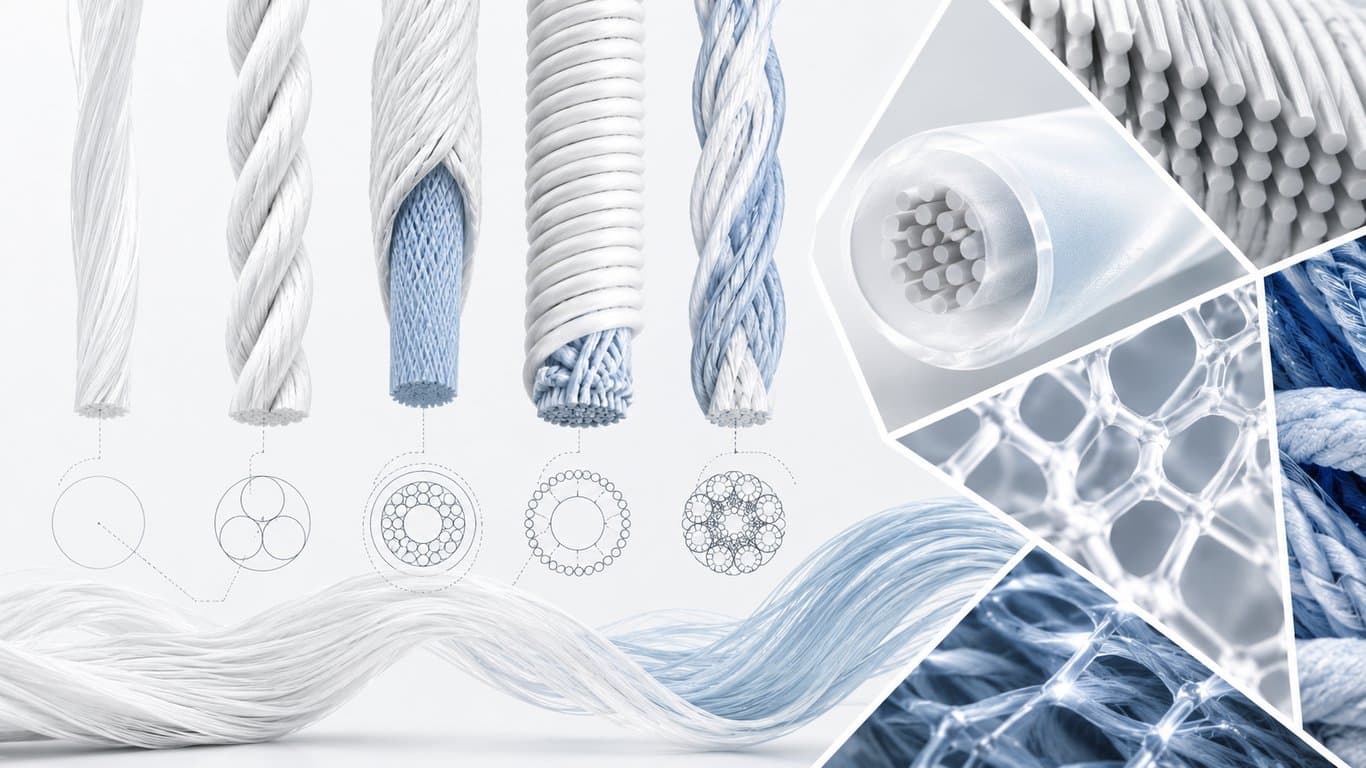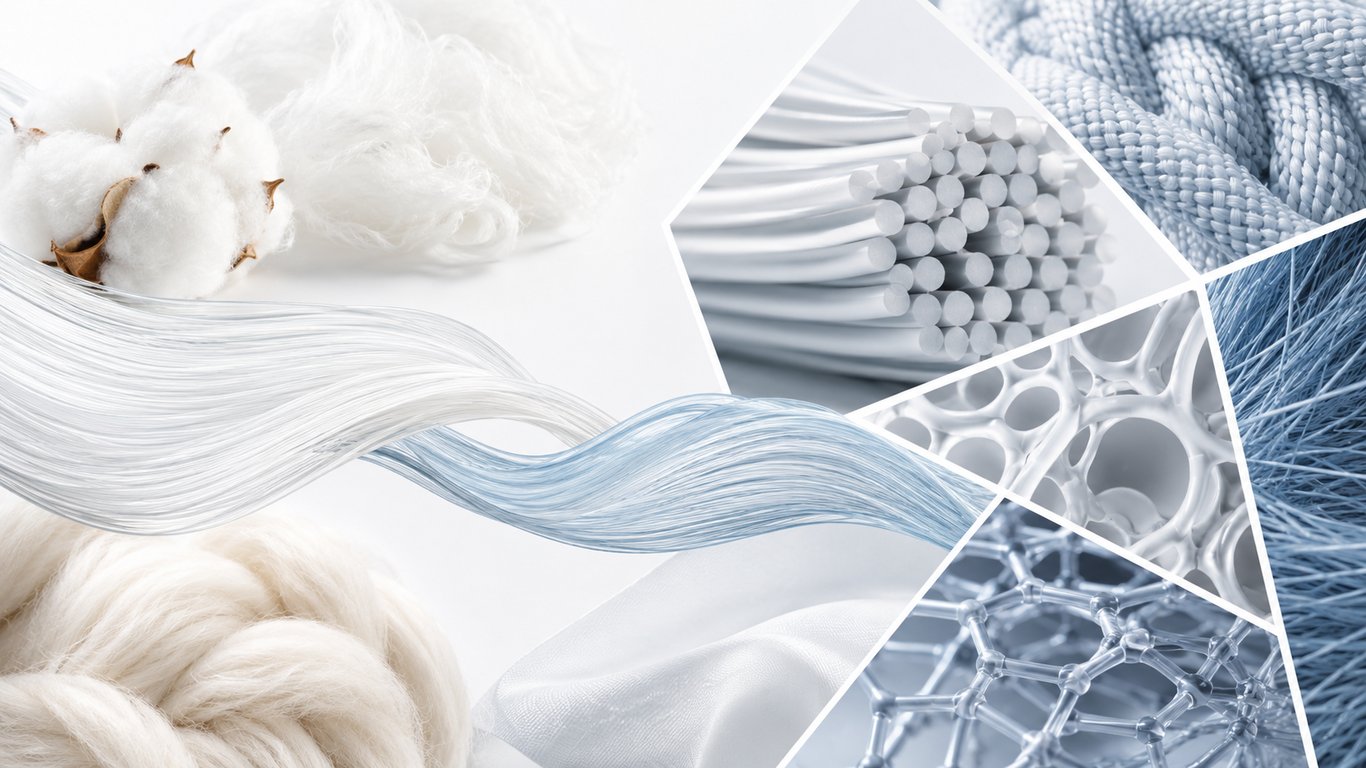
Textile Materials as Fiber Foundations for Yarn Systems
Textile materials begin with fibers.
Before a yarn can be engineered, before a fabric can be constructed, and before a textile product can perform in real use, there must first be a fiber material with its own substance, form, surface behavior, internal structure, and performance potential.
In this knowledge system, textile materials are discussed primarily as fiber materials. This does not mean that yarns, fabrics, and textile products are unimportant. It means that fibers are the starting point. They provide the material foundation that later becomes reorganized through yarn engineering, modification, application design, and failure analysis.
A fiber is not simply a chemical substance. Polyester, cotton, nylon, aramid, wool, viscose, UHMWPE, and carbon fiber are not only different because their compositions are different. They also differ in length, fineness, cross-sectional shape, surface texture, internal structure, moisture behavior, thermal response, friction, flexibility, strength, and processing behavior.
This is why textile materials should not be understood only by fiber names. A more useful way is to look at fibers through three connected attributes:
Substance: what the fiber is made of
Form: how the fiber exists physically
Performance: how the fiber behaves
These three attributes form the foundation of textile material understanding. They also explain why two fibers with similar composition may behave differently, and why two fibers with different composition may sometimes be engineered toward similar application goals.
1. Fibers as the Basic Units of Textile Materials
Fibers are the smallest practical material units in textile systems.
A single fiber may be thin, flexible, and easy to overlook. But once many fibers are arranged, twisted, bonded, wrapped, braided, or otherwise assembled, they can form yarns, ropes, cords, technical structures, reinforcement systems, filters, protective materials, and many other textile-based products.
This is the special nature of textile materials: large-scale performance is created from small-scale fiber behavior.
Unlike many bulk materials, textile materials are not usually formed as solid blocks. They are built from long, slender, flexible units. These units interact through contact, friction, cohesion, entanglement, surface treatment, and structural arrangement. Because of this, textile materials are often flexible, porous, lightweight, anisotropic, and highly dependent on processing history.
A fiber can be viewed in two ways.
First, it is a material object. It has chemical composition, molecular structure, surface characteristics, and measurable properties.
Second, it is a building unit. It becomes part of a larger system only when it is processed into a yarn, fabric, rope, braid, composite, or other textile structure.
This dual identity is important. If we only see fiber as a raw material, we may focus too much on composition and ignore how the fiber behaves in processing. If we only see fiber as part of a finished product, we may forget that many performance problems begin at the fiber level.
For yarn engineering, the fiber is the first decision layer.
Fiber length influences yarn formation. Fiber fineness influences softness and coverage. Fiber surface affects cohesion and friction. Fiber modulus affects flexibility and stiffness. Fiber thermal behavior affects heat setting and high-speed sewing. Fiber moisture behavior affects dimensional stability, comfort, and long-term performance.
A yarn is not just a thicker version of fiber. It is a system that reorganizes fiber properties into a new structure. Understanding textile materials therefore begins with understanding fibers.
2. Evolution of Fiber Materials
The history of fibers is not only a history of material discovery. It is also a history of how people learned to control material form, function, and performance.
Early textile materials came from nature. Plant fibers, animal fibers, and naturally occurring fibrous materials were collected, twisted, bound, woven, and used for clothing, tools, shelter, carrying, protection, and decoration. Natural fibers such as cotton, flax, hemp, wool, and silk became important not only because they were available, but because their structures were already suitable for textile use.
Cotton offered softness and moisture absorption. Wool provided crimp, warmth, and elasticity. Silk provided long continuous filaments, luster, and strength. Flax and hemp offered long plant fibers with useful strength and stiffness. These natural fibers became the models that later artificial fibers tried to imitate, improve, or replace.
The next major stage was regenerated fibers.
Regenerated fibers are made from natural polymers that are dissolved or processed and then re-formed into fiber form. Viscose, modal, and lyocell are typical examples based on regenerated cellulose. These fibers show an important idea in textile material development: people were no longer limited to directly using natural fibers. They could take natural polymer resources and reshape them into more controllable fiber forms.
After regenerated fibers came synthetic fibers.
Synthetic fibers such as polyester, nylon, polypropylene, acrylic, and spandex changed textile production because they could be produced at large scale with relatively stable properties. They allowed better control of strength, elasticity, durability, drying behavior, and cost. However, early synthetic fibers were often too uniform in shape and limited in comfort, moisture behavior, dyeability, or surface feel.
This led to differentiated fibers.
Differentiated fibers are designed by changing fiber form, composition, surface, or accessibility. Examples include profiled fibers, hollow fibers, microfibers, bicomponent fibers, high-shrinkage fibers, elastic fibers, and cationic dyeable polyester. These fibers show a key shift: fiber innovation was no longer only about chemical composition. It became increasingly about morphology, scale, surface, and structure.
High-performance fibers developed for more demanding environments.
Aramid fibers, UHMWPE fibers, carbon fibers, glass fibers, basalt fibers, PBI, PPS, and other specialty fibers are used when ordinary fibers cannot meet requirements for strength, modulus, heat resistance, chemical stability, flame resistance, or protective function. These fibers are not simply “better” fibers in every situation. They are valuable when a specific performance requirement justifies higher cost, more difficult processing, or more limited availability.
More recently, fiber development has moved toward functional and smart behavior.
Functional fibers may provide conductivity, antistatic behavior, antimicrobial performance, flame retardancy, moisture management, UV resistance, thermal regulation, filtration, adsorption, optical response, or biocompatibility. Smart fibers may respond to heat, light, moisture, pressure, strain, electricity, or chemical environments.
This development path can be summarized as:
Natural fibers
→ Regenerated fibers
→ Synthetic fibers
→ Differentiated fibers
→ High-performance fibers
→ Functional fibers
→ Smart and adaptive fibers
This evolution matters because it shows that fiber development is not only about discovering new materials. It is about learning how to design fiber substance, fiber form, and fiber performance together.
3. Fiber Classification
Fiber classification helps organize textile material knowledge, but no single classification method is enough.
A fiber may be classified by origin, by chemical substance, by physical form, by performance, by processing method, or by application function. Each method reveals something different.
A cotton fiber and a viscose fiber may both be cellulose-based, but one is natural and the other is regenerated. Polyester and aramid are both synthetic polymer fibers, but their performance and application logic are very different. Glass fiber and carbon fiber may both be high-performance reinforcement fibers, but their substance, surface behavior, and processing requirements are not the same.
For practical yarn engineering, classification should help answer three questions:
What is the fiber made of?
What physical form does the fiber have?
What performance role can the fiber support?
3.1 Natural Fibers
Natural fibers come directly from plants, animals, or mineral sources.
Common examples include:
Cotton
Flax
Hemp
Jute
Wool
Silk
Cashmere
Other plant and animal fibers
Natural fibers often have complex morphology and internal structure. Cotton has a twisted ribbon-like form. Wool has surface scales and natural crimp. Silk exists as a long filament with natural luster and smoothness. Bast fibers such as flax and hemp have long fibrous structures that contribute to strength and stiffness.
The value of natural fibers is not only their chemical composition. Their form and structure are often difficult to fully reproduce artificially.
3.2 Regenerated Fibers
Regenerated fibers are made by taking natural polymers and re-forming them into fibers.
Typical examples include:
Viscose
Modal
Lyocell
Regenerated cellulose fibers
Regenerated protein-related fibers
Chitosan-related fibers
Regenerated fibers sit between natural and synthetic systems. Their substance may come from natural polymers, but their fiber form is created through artificial processing. This gives them more controllable fineness, length, and uniformity than many natural fibers, while still retaining some natural-polymer characteristics such as moisture affinity.
3.3 Synthetic Fibers
Synthetic fibers are made from artificially synthesized polymers.
Common examples include:
Polyester
Nylon
Polypropylene
Acrylic
Spandex
Polyethylene
Specialty synthetic polymers
Synthetic fibers are widely used because they are scalable, consistent, and highly designable. Polyester offers cost-performance balance and dimensional stability. Nylon offers abrasion resistance and toughness. Polypropylene is lightweight and chemically resistant. Spandex provides high elasticity.
However, synthetic fibers may also face limitations, such as low moisture regain, heat sensitivity, static accumulation, dyeing challenges, or poor surface adhesion depending on the polymer type and fiber design.
3.4 Inorganic and Mineral Fibers
Inorganic and mineral fibers are used where organic fibers may not provide enough heat resistance, dimensional stability, electrical insulation, or reinforcement performance.
Examples include:
Glass fiber
Basalt fiber
Metal fiber
Ceramic fiber
Mineral fiber systems
These fibers are often used in insulation, reinforcement, filtration, fire resistance, composite structures, and technical applications. They are usually less suitable for comfort-oriented textile products but valuable in engineering environments.
3.5 High-Performance Fibers
High-performance fibers are selected when ordinary textile fibers cannot meet extreme requirements.
Examples include:
Aramid fiber
UHMWPE fiber
Carbon fiber
PBI fiber
PPS fiber
High-performance polyethylene or polyimide-based fibers
These fibers may offer high strength, high modulus, thermal resistance, cut resistance, flame resistance, chemical stability, or lightweight reinforcement. Their value depends on application context. A high-performance fiber is not automatically the best choice for every yarn. It must match the intended structure, processing route, cost level, and use environment.
3.6 Functional Fibers
Functional fibers are designed to provide specific behaviors beyond basic strength, softness, or durability.
Examples include:
Conductive fibers
Antistatic fibers
Antimicrobial fibers
Flame-retardant fibers
UV-resistant fibers
Moisture-management fibers
Phase-change fibers
Photochromic or thermochromic fibers
Biocompatible fibers
Functional fibers are important because many modern textile products require more than mechanical performance. A fiber may need to sense, conduct, absorb, release, resist, shield, protect, or respond.
4. The Three Core Fiber Attributes: Substance, Form, and Performance
To understand textile materials properly, fiber classification is only the beginning.
A more useful framework is to examine fibers through three connected attributes:
Substance → Form → PerformanceSubstance explains what the fiber is made of. Form explains how the fiber physically exists. Performance explains how the fiber behaves.
The reason this framework matters is simple: fiber performance is not determined by composition alone. A fiber’s properties are shaped by its chemical substance, physical form, surface behavior, internal structure, and processing history.
For example, two polyester fibers can behave differently if one is a round filament and the other is a profiled microfiber. Two cellulose fibers can behave differently if one is natural cotton and the other is regenerated viscose. Two high-strength fibers can show different processing behavior if their surfaces interact differently with coating, twisting, or resin systems.
This is why the substance–form–performance relationship becomes the core of textile material understanding.
4.1 Fiber Substance
Fiber substance refers to what the fiber is made of.
It includes chemical composition, polymer type, component ratio, additives, crystalline tendency, molecular structure, and material origin. In practical terms, fiber substance tells us the basic performance boundary of the fiber.
A cellulose-based fiber will usually behave differently from a protein-based fiber. A polyester fiber will behave differently from nylon. An aramid fiber will behave differently from UHMWPE. Glass fiber and carbon fiber belong to a very different material family from ordinary apparel fibers.
Fiber substance influences:
Strength potential
Elongation behavior
Heat resistance
Moisture affinity
Chemical resistance
Dyeing behavior
Aging behavior
Burning or melting behavior
Biological compatibility
Recycling pathway
Substance is often the first thing people notice when selecting materials. Buyers may ask for polyester, nylon, cotton, aramid, UHMWPE, viscose, or recycled fiber. But substance alone does not give the full answer.
A polyester staple fiber, polyester filament, polyester microfiber, profiled polyester, hollow polyester, recycled polyester, and cationic dyeable polyester all belong to polyester-based systems, but they do not behave the same. Their differences come from form, structure, surface, processing, and intended function.
This is why fiber substance should be treated as the starting point, not the whole story.
4.2 Fiber Form
Fiber form is one of the most important ideas in textile materials.
In many material fields, people focus heavily on composition. In textile materials, form is equally important. Fibers are long, slender, flexible, surface-rich units. Their performance depends strongly on how they are shaped, scaled, surfaced, and internally organized.
Fiber form can be understood through four elements:
Morphology
Scale
Surface
Structure
These four elements should be considered together because they often influence each other. A fiber’s cross-section affects surface area. Its fineness affects flexibility and cohesion. Its surface roughness affects friction. Its internal structure affects strength and thermal behavior.
4.2.1 Morphology
Morphology refers to the visible or geometric form of the fiber.
Important morphology factors include:
Fiber length
Cross-sectional shape
Crimp
Curl
Twist-like natural form
Branching
Hollow shape
Longitudinal appearance
Apparent surface shape
Fiber length is one of the most basic morphology factors. Staple fibers must be long enough and uniform enough to form stable yarns through spinning or secondary processing. Filaments, by contrast, provide continuous length and can be used directly in twisting, covering, braiding, or reinforcement systems.
Cross-sectional shape also matters. Round fibers, triangular fibers, flat fibers, hollow fibers, multi-lobal fibers, and irregular natural fibers do not behave the same. Cross-section affects luster, hand feel, coverage, bending behavior, moisture movement, and surface interaction.
Crimp and curl affect fiber cohesion and bulk. Wool, for example, has natural crimp that contributes to elasticity and warmth. Synthetic fibers may be textured or crimped to improve bulk, stretch, softness, or processing behavior.
Morphology is not just appearance. It affects how fibers gather, slide, bend, pack, and hold together.
4.2.2 Scale
Scale refers to the size level of the fiber and its features.
Important scale factors include:
Fiber fineness
Diameter
Length
Aspect ratio
Hollow ratio
Micro-scale surface features
Nano-scale internal or surface features
Fiber fineness strongly affects textile behavior. Finer fibers usually provide softer hand feel, greater surface area, better coverage, and different bending behavior. However, very fine fibers may also create higher surface friction, more processing difficulty, or different pilling behavior depending on the system.
Scale is closely connected to surface area. As fibers become finer, the surface area per unit mass increases. This changes friction, cohesion, dyeing behavior, moisture interaction, coating behavior, and filtration performance.
The scale of fibers also links textile materials with modern material science. Many fiber behaviors are controlled not only at the millimeter or micrometer level, but also through microstructures and nanoscale features. Surface grooves, fibrillar structures, pores, and molecular orientation can all influence final performance.
A fiber may be small, but its scale can control large product behavior.
4.2.3 Surface
Fiber surface is where many textile interactions happen.
Fibers do not work alone. They touch other fibers, machine parts, coatings, finishes, dyes, resins, adhesives, skin, fabrics, and environmental materials. Because of this, fiber surface behavior often determines whether a material can be processed, bonded, dyed, coated, twisted, sewn, or used reliably.
Important surface factors include:
Roughness
Smoothness
Grooves
Scales
Surface energy
Surface chemistry
Friction
Adhesion
Wettability
Lubrication behavior
Coating compatibility
Dyeing accessibility
A rough surface may improve fiber cohesion but increase friction during processing. A smooth surface may reduce friction but reduce bonding or cohesion. A low-energy surface may resist wetting or coating. A chemically active surface may accept finishing treatments more easily.
Surface behavior is especially important in yarn engineering. Fiber friction affects spinning stability, hairiness, twist efficiency, and yarn cohesion. In covering, wrapping, braiding, and composite structures, surface compatibility may determine whether different materials work together or fail apart.
Surface is not a minor detail. For many textile materials, surface is where performance begins.
4.2.4 Structure
Fiber structure refers to internal organization and arrangement.
This includes both molecular-level structure and larger internal features. Important structural factors include:
Molecular chain structure
Molecular orientation
Crystalline regions
Amorphous regions
Fibrillar structure
Layered structure
Cell wall structure
Pores
Voids
Internal defects
Component distribution in bicomponent fibers
Structure influences how a fiber carries load, responds to heat, absorbs moisture, changes dimensions, resists chemicals, and ages over time.
Crystalline regions often contribute to strength, stiffness, thermal stability, and dimensional stability. Amorphous regions may contribute to dyeability, moisture interaction, flexibility, or shrinkage behavior. Molecular orientation can improve strength and modulus, but may also influence brittleness or thermal shrinkage.
Natural fibers often have complex internal structures that are difficult to imitate. Cotton, wool, silk, flax, and other natural fibers have layered, fibrillar, or biologically formed structures. Synthetic fibers can be engineered through spinning, drawing, heat treatment, texturing, and bicomponent design to create controlled structures.
Structure is the hidden part of fiber form. It is not always visible, but it often explains why a fiber performs the way it does.
4.3 Fiber Performance
Fiber performance describes how a fiber behaves under mechanical, thermal, chemical, environmental, biological, and processing conditions.
Performance is the result of both substance and form. It should not be read as a simple material label. Instead, it should be evaluated according to the final use and the processing route.
A fiber used for sewing thread may need strength, elongation, heat resistance, friction control, and lubrication compatibility. A fiber used for footwear may need abrasion resistance and flex fatigue resistance. A fiber used for filtration may need chemical stability, pore control, and dimensional stability. A fiber used for protective textiles may need cut resistance, flame resistance, thermal stability, or high modulus.
4.3.1 Mechanical Performance
Mechanical performance includes:
Tensile strength
Elongation
Modulus
Toughness
Flexibility
Bending behavior
Fatigue tendency
Creep behavior
Recovery behavior
Strength is important, but it is not the only mechanical property. A fiber with high strength but low flexibility may not be suitable for repeated bending. A fiber with good elongation may be useful in dynamic structures but unsuitable for applications that require dimensional stability.
Mechanical behavior must always be interpreted through application stress.
4.3.2 Thermal Performance
Thermal performance includes:
Melting behavior
Softening behavior
Thermal shrinkage
Heat resistance
Heat aging
Heat setting response
Thermal insulation behavior
Flame response
Synthetic fibers often have clear melting or softening behavior. Natural fibers may degrade rather than melt. High-performance fibers may be selected when ordinary fibers cannot withstand heat exposure.
Thermal behavior matters in high-speed sewing, heat setting, automotive interiors, protective clothing, industrial filtration, electrical insulation, and many other textile systems.
4.3.3 Moisture-Related Performance
Moisture-related performance includes:
Moisture regain
Water absorption
Swelling
Drying behavior
Hydrolysis sensitivity
Moisture transport
Dimensional change under humidity
Moisture behavior affects comfort, processing, dyeing, dimensional stability, biological growth, and long-term durability. Cotton, viscose, wool, polyester, nylon, and polypropylene all interact with moisture differently.
In yarn systems, moisture behavior can affect tension, friction, shrinkage, and performance consistency.
4.3.4 Chemical Performance
Chemical performance includes resistance to:
Acids
Alkalis
Solvents
Oxidation
Detergents
Oils
Industrial chemicals
Cleaning agents
Chemical stability becomes important in industrial textiles, protective clothing, filtration, medical textiles, outdoor use, washing, coating, finishing, and recycling processes.
A fiber may look unchanged after chemical exposure but still lose strength internally. This is why chemical performance must be evaluated carefully when fibers are used in demanding environments.
4.3.5 Optical Performance
Optical performance includes:
Luster
Whiteness
Transparency
Color behavior
Dye appearance
UV stability
Photo-degradation behavior
The optical behavior of fibers matters not only in fashion and appearance. UV stability is critical for outdoor textiles, agricultural nets, ropes, tents, tarps, and geotextiles. Luster and cross-section also affect product appearance and perceived quality.
4.3.6 Electrical Performance
Electrical performance includes:
Conductivity
Antistatic behavior
Dielectric behavior
Charge accumulation
Electromagnetic shielding potential
Most common textile fibers are insulating, which can lead to static problems in synthetic fibers. Conductive fibers, carbon-based fibers, metal fibers, and specially treated fibers are used when electrical behavior becomes part of the design requirement.
Electrical performance is increasingly important in smart textiles, protective textiles, antistatic workwear, sensors, heating systems, and electronic textile components.
4.3.7 Surface Performance
Surface performance includes:
Friction
Cohesion
Adhesion
Smoothness
Roughness
Abrasion tendency
Pilling tendency
Coating compatibility
Lubrication response
Surface performance is often where processing and application problems appear first. A yarn may break during sewing because of friction. A fabric may pill because of fiber migration and surface abrasion. A coating may fail because the fiber surface is incompatible.
For yarn engineering, surface performance is one of the most practical fiber attributes.
4.3.8 Biological and Safety-Related Performance
Biological and safety-related performance includes:
Skin contact behavior
Microbial resistance
Biocompatibility
Allergenic or irritation tendency
Ecological safety
Degradation behavior
Toxicity concerns
Hygiene-related behavior
This area matters in apparel, medical textiles, hygiene products, protective textiles, baby products, bedding, sportswear, and sustainability-focused materials.
A fiber used close to the body must be evaluated differently from a fiber used in reinforcement or industrial filtration. Safety and biological behavior are part of material performance, not separate from it.
4.4 Substance–Form–Performance Relationship
The most important lesson in textile materials is that performance does not come from substance alone.
A fiber’s behavior is created through the relationship between:
Substance + Form + Processing History → PerformanceSubstance sets the basic material boundary. Form determines how that material exists as a fiber. Processing changes both form and structure. Performance is the result that appears in testing, production, and real use.
This relationship explains many practical textile problems.
Two fibers with the same polymer may behave differently because their fineness, cross-section, surface treatment, or internal orientation are different. Two fibers with different chemical substances may sometimes be engineered toward similar performance if their form and structure are designed properly. A high-performance fiber may fail in application if its surface is unsuitable for bonding, coating, or twisting. A low-cost fiber may perform well if its structure and processing route fit the application.
For yarn engineering, this relationship is essential.
If the fiber substance is correct but the form is unsuitable, yarn formation may be unstable. If the fiber form is good but the surface is incompatible, friction or cohesion problems may appear. If the fiber performance is strong in laboratory testing but weak under heat, moisture, or flexing, the final product may still fail.
This is why material selection should not begin and end with fiber name. It should ask:
What is the fiber made of?
What form does the fiber have?
How does the fiber surface behave?
What internal structure controls performance?
What processing history has the fiber experienced?
What application conditions will the fiber face?
How will the fiber behave once organized into a yarn system?
This is the foundation of textile material thinking.
5. Fiber Processing and Initial Treatment Effects
Fibers do not enter yarn engineering in a neutral state.
Most fibers have already been affected by growth, extraction, regeneration, spinning, drawing, heat treatment, cutting, crimping, texturing, surface treatment, packaging, storage, or recycling. These processes can improve fiber performance, but they can also introduce damage or variability.
Processing should therefore be understood as part of fiber material identity.
5.1 Natural Fiber Initial Processing
Natural fibers usually require initial processing before they can be used in textile systems.
Examples include:
Cotton ginning
Flax or hemp retting and degumming
Wool scouring
Silk reeling
Fiber cleaning
Opening and blending
Removal of impurities
These steps influence fiber length, cleanliness, surface condition, moisture behavior, and processing stability. Poor initial processing may damage fibers, create uneven quality, increase waste, or reduce later yarn performance.
For example, cotton fiber damage during ginning or opening may reduce effective fiber length and increase short fiber content. Wool scouring may influence surface condition and residual grease. Bast fiber degumming affects fiber separation, flexibility, and spinnability.
Initial processing is not just preparation. It changes what the fiber can become.
5.2 Chemical Fiber Formation
Chemical fibers are formed through controlled manufacturing processes.
Typical steps may include:
Polymer preparation
Spinning
Drawing
Heat treatment
Crimping
Texturing
Cutting into staple
Surface finishing
Package formation
These processes control fiber fineness, molecular orientation, crystallinity, surface finish, strength, elongation, shrinkage, and processing behavior.
Drawing can improve molecular orientation and strength. Heat treatment can improve dimensional stability. Texturing can increase bulk and elasticity. Surface finishing can reduce friction and improve downstream processing.
For synthetic and regenerated fibers, manufacturing is already a form of material design.
5.3 Processing-Induced Fiber Damage
Processing can also damage fibers.
Common forms of processing damage include:
Fiber length reduction
Surface abrasion
Fibrillation
Thermal damage
Chemical degradation
Loss of strength
Increased brittleness
Change in color or whiteness
Unstable crimp
Uneven finish
Contamination
Damage may not always be visible. A fiber can look acceptable but still have reduced strength, poor cohesion, unstable thermal behavior, or weaker resistance to later processing.
This is especially important in recycled fibers, delicate natural fibers, high-performance fibers, and fibers used in demanding technical applications.
5.4 Processing as Performance Control
Processing is not only a risk. It is also one of the main ways to improve fiber performance.
Examples include:
Drawing to improve strength and orientation
Heat setting to improve dimensional stability
Surface treatment to improve adhesion or friction behavior
Texturing to improve bulk and stretch
Crimping to improve cohesion and softness
Cutting to control staple length
Finishing to improve processing stability
In practical fiber selection, processing history should be part of the material evaluation. A fiber is not only “polyester” or “nylon.” It is a polyester or nylon fiber with a particular formation route, finish, structure, and treatment history.
6. Fiber Identification and Quality Evaluation
Fiber identification and quality evaluation are essential because fiber names alone are not enough.
In trade, development, and production, a material may be described as polyester, nylon, cotton, aramid, recycled fiber, blended fiber, or functional fiber. But for real engineering work, the fiber must be verified and evaluated.
Identification answers the question:
What is this fiber?Quality evaluation answers another question:
Is this fiber suitable and consistent enough for the intended yarn system?Both questions matter.
6.1 Visual and Microscopic Identification
Visual and microscopic observation can reveal important fiber characteristics.
Observation may include:
Longitudinal morphology
Cross-sectional shape
Surface texture
Natural scales
Grooves
Hollow features
Crimp
Fibrillation
Damage
Contamination
Microscopy is especially useful when comparing natural fibers, regenerated fibers, synthetic fibers, and blends. It can also help diagnose processing damage, surface abrasion, poor blending, or fiber inconsistency.
For a small yarn development lab, microscopic observation is one of the most practical and cost-effective tools.
6.2 Physical Identification
Physical identification uses measurable behavior to distinguish fibers.
Common methods include:
Density comparison
Burning behavior
Melting behavior
Moisture behavior
Thermal response
Solubility tendency
Shrinkage behavior
Burning tests and density tests are basic methods, but they should not be the only basis for identification when accuracy matters. Many fibers are modified, blended, coated, or finished, which can affect simple test results.
Physical identification is useful as a first screening method, especially when combined with microscopy and supplier documentation.
6.3 Chemical and Instrumental Identification
More advanced identification methods may include:
Chemical solubility testing
Staining methods
FTIR
Thermal analysis
SEM
AFM
X-ray analysis
Other instrumental methods
These methods are useful when fiber composition, structure, or modification must be verified more accurately.
A small development center does not need to own every advanced instrument at the beginning. Many advanced tests can be outsourced to laboratories. What matters is knowing when simple observation is enough and when professional testing is required.
6.4 Quality Evaluation for Yarn Engineering
For yarn engineering, fiber quality evaluation should focus on whether the fiber can support the intended structure and performance.
Important evaluation factors include:
Fiber length
Length uniformity
Fineness
Strength
Elongation
Modulus
Moisture regain
Surface friction
Crimp stability
Thermal shrinkage
Cleanliness
Finish level
Batch consistency
Processing stability
Different yarn systems require different evaluation priorities.
A fiber for spinning may require good length distribution and cohesion. A filament for twisting may require strength, elongation consistency, and stable finish. A fiber for covering may require surface compatibility. A fiber for high-performance cord may require high strength, fatigue behavior, and low batch variation.
Quality evaluation is not only about passing a test. It is about understanding whether the fiber can become the yarn system you want to design.
7. Fiber Selection for Yarn Engineering
Fiber selection is the bridge between textile materials and yarn engineering.
In yarn development, the goal is rarely to choose the “best” fiber in general. The goal is to choose a fiber that fits the structure, process, application, and cost target.
A fiber should be selected according to what the yarn needs to do.
7.1 Fiber Substance and Yarn Design
Fiber substance sets the performance boundary.
Polyester may be selected for durability, cost-performance balance, dimensional stability, and broad availability. Nylon may be selected for abrasion resistance and toughness. Cotton may be selected for comfort and moisture absorption. Aramid may be selected for heat resistance or protective performance. UHMWPE may be selected for high strength or cut resistance.
But each material also brings limitations.
Polyester may have low moisture regain. Nylon may absorb more moisture and change dimensions. Cotton may lack high industrial strength. Aramid may be costly and difficult to process. UHMWPE may have a slippery surface and thermal limitations.
Material selection is always a balance.
7.2 Fiber Form and Yarn Formation
Fiber form strongly affects yarn formation.
Fiber length affects spinning stability and strength utilization. Fiber fineness affects yarn softness, coverage, and uniformity. Fiber surface affects cohesion and friction. Crimp affects bulk and fiber holding power. Internal structure affects strength, elasticity, and thermal response.
For example, a fiber may have good strength but poor cohesion. Another may have excellent softness but insufficient abrasion resistance. A filament may be strong and clean but too smooth for certain composite or wrapped structures without surface treatment.
Yarn engineering reorganizes fiber form. But it cannot fully ignore the fiber’s original form.
7.3 Fiber Performance and Application Suitability
Fiber performance must be matched to application conditions.
A yarn used in apparel may need flexibility, wash resistance, and comfort. A yarn used in footwear may need abrasion resistance and flex fatigue resistance. A yarn used in automotive interiors may need heat stability and long-term durability. A yarn used in protective textiles may need cut, heat, flame, or impact resistance. A yarn used in filtration may need chemical stability and dimensional control.
Selection should begin from the application requirement, but it must return to fiber-level behavior.
If the application involves heat, the fiber’s thermal performance matters. If the application involves friction, surface and abrasion behavior matter. If the application involves repeated bending, fatigue behavior matters. If the application involves moisture, chemical or biological exposure, those properties must be evaluated before yarn design.
7.4 Fiber Evaluation Before Yarn Development
Before developing a yarn system, the fiber should be evaluated with the intended structure in mind.
Useful questions include:
Is the fiber length suitable?
Is the fiber fineness appropriate?
Does the surface provide enough cohesion or too much friction?
Does the fiber have the required strength and elongation?
Will the fiber tolerate heat setting, coating, twisting, covering, or sewing?
Is the fiber stable under moisture, washing, UV, or chemicals?
Does the fiber batch quality remain consistent?
Does the fiber fit the cost and supply requirements?
This evaluation prevents many later problems.
Many yarn failures begin because fiber selection was based only on material name or price. A better approach is to evaluate the fiber as a complete material system: substance, form, performance, processing history, and application fit.
Summary
Textile materials begin with fibers.
In this MAP, textile materials are treated as fiber foundations for yarn systems. A fiber should not be understood only by its name or chemical composition. It should be understood through its substance, form, performance, processing history, and suitability for later yarn engineering.
Fiber substance explains what the fiber is made of. Fiber form explains how the fiber physically exists through morphology, scale, surface, and structure. Fiber performance explains how the fiber behaves under mechanical, thermal, moisture, chemical, surface, electrical, optical, biological, and processing conditions.
The most useful textile material understanding comes from connecting these attributes:
Substance + Form + Processing History → PerformanceThis framework helps explain why fibers behave differently, why similar materials can produce different yarn results, and why fiber selection must be connected to application requirements.
For yarn engineering, fibers are not passive raw materials. They are active design units. Their properties become reorganized through yarn structure, adjusted through modification systems, tested through applications, and diagnosed through failure analysis.
A strong textile material knowledge system therefore starts with one simple but important idea:
To understand yarn, first understand fiber.